Who is an auditor
An auditor evaluates whether a management system meets the applicable requirements — with competence, impartiality and clear evidence. This page explains the role, the people you meet in an audit team, and how someone can progress toward auditor and lead auditor competence.
The role
In management system certification, an auditor is the person who conducts the audit: gathering objective evidence, evaluating conformity to the reference standard and reporting findings.
Audits are planned and performed so that conclusions are based on evidence — not on assumptions or commercial pressure.
Competence
Competence means the ability to apply knowledge and skills to achieve intended audit results. It covers the reference standard, audit principles and methods, and the sector context of the organisation being audited.
Certification bodies select, train, monitor and authorise people before they act as auditors. Course frameworks registered with schemes such as CQI-IRCA, AICQ-SICEV or KHC are examples of recognised training pathways; they are not, by themselves, a DAS appointment.
Impartiality
Impartiality and ethical conduct are foundational. Auditors must avoid conflicts of interest, protect confidential information and not provide consultancy that would compromise independence on the same client.
D.A.S. maintains documented impartiality arrangements for certification activities.
Roles in the audit team
An audit team can include several roles. Only a qualified auditor conducts audit activities that count toward the audit.
- Lead auditor
- Leads the team, manages the audit plan, opening and closing meetings and the report.
- Auditor
- Carries out audit activities on the processes assigned by the lead auditor.
- Technical expert
- Provides specific sector knowledge to the team. Does not act as an auditor and is not counted in audit man-days.
- Auditor in training
- Participates under the direction of a qualified auditor. Their time is not counted in the audit duration.
- Observer
- Attends without auditing — for example an accreditation body witness. The organisation is informed in advance.
How to become an auditor
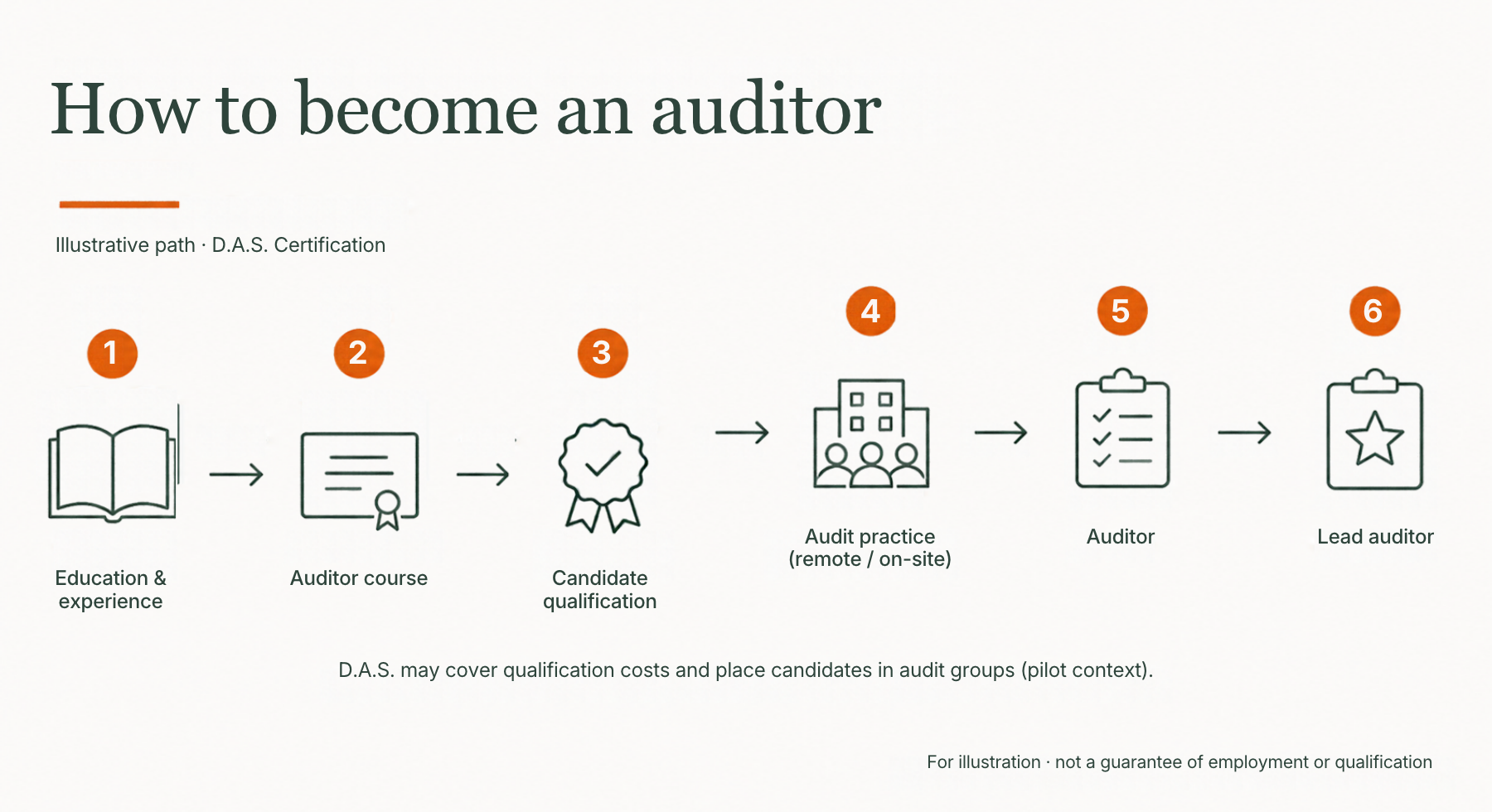
Becoming an auditor is a competence path: education and experience, an auditor course covering the standard and audit norms, qualification as a candidate, supervised practice in real audits, then auditor authorisation and, later, lead auditor competence.
Documented qualification criteria (D.A.S. procedure Pro 05)
The following thresholds come from the internal D.A.S. procedure Pro 05 Qualifica Auditor. They describe how D.A.S. qualifies auditors; they are not a public promise to any individual candidate.
- Initial access: auditor course covering the reference standard, ISO/IEC 17021 and ISO 19011; diploma or degree; at least 5 years’ relevant work experience (reducible to 3 for graduates or specific professional courses), of which at least 2 years related to the management system scheme.
- Training: at least 20 man-days of accompanied practice, including planning, audit plan, opening and closing meetings, conformity methods (observation, interview, document review) and reporting. Man-days include planning (1 M/D), stage 1 and stage 2 / surveillance / renewal days as applicable.
- After auditor qualification, the lead auditor path requires training audits with a D.A.S. lead auditor: typically 4 audits covering planning, conduct and reporting, totalling at least 15 man-days (more audits if the day total is not met).
- Sector extension: 10 accompanied audits in the new sector. Technical experts support the team and do not count toward man-days. Ethics and confidentiality undertakings apply to all auditors and experts.
Sources
- ISO 19011 — Guidelines for auditing management systems (roles, competence, principles).
- ISO/IEC 17021-1 — Requirements for bodies providing audit and certification of management systems (personnel competence, training, authorization).
- D.A.S. procedure Pro 05 Qualifica Auditor (internal qualification thresholds cited above).